Everything you need
to know about yields.
From DeFi basics to advanced alert configuration. Answered clearly, without jargon.
Last updated
About EchoTerminal
EchoTerminal is a free DeFi yield aggregator. Browse live supply and borrow rates across 10 protocols and 32 networks without signing up. An account unlocks watchlists, alerts, and a portfolio calculator.
#What is EchoTerminal?
EchoTerminal is a DeFi yield intelligence platform that aggregates supply and borrow rates across major lending protocols and networks into one unified matrix. Instead of visiting Aave, Morpho, Compound, and Spark separately, you see every pool in one place: live APY, TVL, historical charts, and threshold alerts.
#Do I need a wallet or account to browse yields?
No. The yield matrix is fully public. Browse every pool, compare rates, and view pool detail charts without connecting a wallet or creating an account. An account is only required to save watchlists, set alerts, and sync your calculator positions across devices.
#Is EchoTerminal free?
Yes. The core yield matrix, pool detail views, search, and filtering are free with no account required. Watchlists, alerts, and the portfolio calculator are free with a free account.
#How is EchoTerminal different from DefiLlama?
DefiLlama is a broad DeFi data aggregator covering protocols, bridges, stablecoins, and more. EchoTerminal focuses specifically on yield intelligence across lending markets: supply APY, borrow APY, TVL, threshold alerts, and a portfolio yield calculator, all in one place.
DeFi Basics
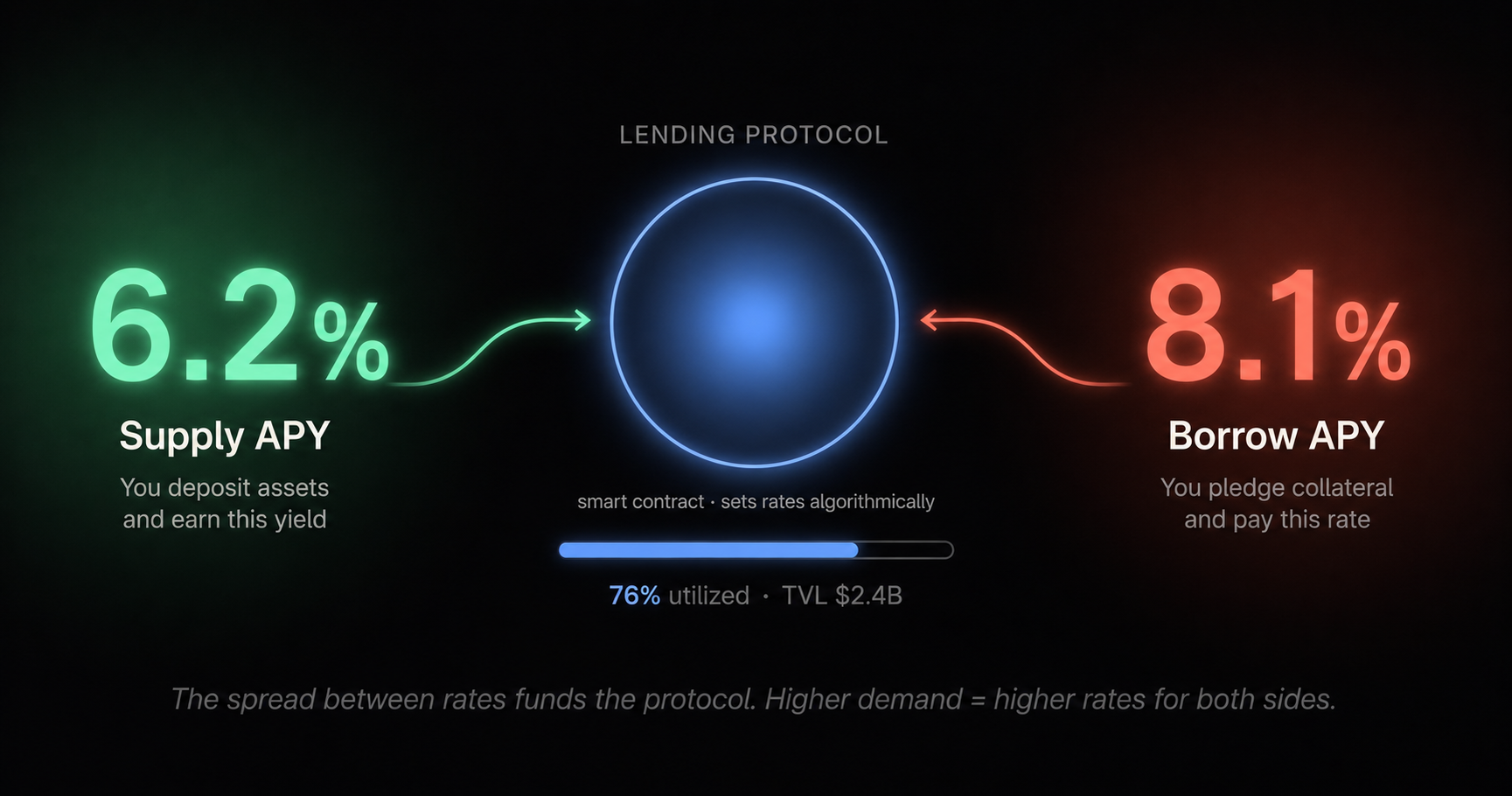
DeFi lending protocols pool deposits and lend them to borrowers via smart contracts. Supply APY is what you earn; Borrow APY is what you pay. Total APY combines organic yield (durable) and token incentives (temporary). TVL measures pool depth — low TVL means liquidity risk.
#What is a DeFi protocol?
A DeFi (Decentralised Finance) protocol is a set of smart contracts deployed on a blockchain that deliver lending, borrowing, and trading without a central intermediary. Unlike a bank, the rules are encoded in code, publicly auditable, and execute automatically. Anyone with a crypto wallet can interact with them directly.
#What is a lending protocol?
A lending protocol is a DeFi protocol that pools deposited crypto assets and lends them out to borrowers. Suppliers earn interest; borrowers pay it. The protocol's smart contract manages everything: interest rate calculation, collateral requirements, and liquidations. Examples tracked by EchoTerminal include Aave, Morpho, Compound, Spark, and Fluid.
#What is Supply APY?
Supply APY (Annual Percentage Yield) is the annualised interest rate you earn when you deposit an asset into a lending protocol. If USDC shows a Supply APY of 6.2%, a deposit of $10,000 would earn approximately $620 over a year. Rates are variable and update with every block based on borrowing demand, so treat that figure as a starting point, not a guarantee.
#What is Borrow APY?
Borrow APY is the annualised interest rate you pay when you borrow an asset from a lending protocol. To borrow, you must first deposit collateral worth more than the amount you want to borrow. Borrow APY is always higher than Supply APY on the same asset. That spread is how the protocol funds its operations.
#What is the difference between APY and APR?
- APR (Annual Percentage Rate) is the simple annual interest rate with no compounding. If you earn 1% per month, your APR is 12%.
- APY (Annual Percentage Yield) accounts for compounding: earning interest on your interest. The same 1% per month compounds to an APY of roughly 12.68%.
- DeFi protocols typically quote APY. EchoTerminal displays APY throughout so numbers are comparable across protocols.
#What is Base APY vs Incentive APY vs Total APY?
- Base APY is the organic yield paid by borrowers. It holds as long as borrowing demand does.
- Incentive APY is a token reward layered on top, usually paid in the protocol's governance token (e.g. COMP, AAVE). These rewards can disappear if a protocol ends its incentive programme.
- Total APY = Base APY + Incentive APY. EchoTerminal shows all three so you can judge how much of a yield is durable versus incentive-driven.
#What is TVL and why does it matter?
TVL (Total Value Locked) is the total dollar value of assets currently deposited in a protocol or pool. Higher TVL signals deeper liquidity: you can deposit or withdraw large amounts without moving the market. Very low TVL pools may advertise higher APYs but carry real liquidity risk if many depositors try to exit at once.
Comparing & Finding Yields
Use the heatmap for a quick overview and Table View for sortable, filterable pool data. Same asset, different APY across protocols means different borrowing demand — not a data error. The 7D and 30D average columns help you spot fleeting spikes vs. durable rates.
#How do I compare yields across protocols?
Open the Yields page and use the supply/borrow toggle to switch modes. The heatmap view shows the best rate per asset per protocol at a glance, colour-coded by intensity. Switch to Table View for a sortable list of all 1,000+ pools with full APY, TVL, and 7D/30D averages. Use the Filters drawer to narrow by network, TVL floor, or APY range.
#Which protocols does EchoTerminal track?
EchoTerminal tracks Aave, Morpho, Compound, Spark, Kamino, Jupiter Lend, JustLend, Fluid, Venus, and AllBridge — 10 protocols in total. New protocols are added as they meet the TVL threshold for inclusion.
#Which networks are supported?
EchoTerminal covers 32 networks: Ethereum, Arbitrum, Base, Optimism, Polygon, Avalanche, BSC, Solana, Gnosis, Scroll, Linea, ZKsync Era, Mantle, Celo, Sonic, Unichain, Tron, SUI, Metis, Monad, Soneium, HyperEVM, Ink, Algorand, Stacks, Story, Katana, Plasma, X Layer, and more. Each pool shows its network in the table so you can filter down to the chains you actively use.
#Why does the same asset show different APYs on different protocols?
Each protocol has its own liquidity pool with independent supply and demand. If USDC borrowing demand is higher on Aave than on Compound, Aave's USDC Supply APY will be higher. Protocol architecture also matters: Morpho's isolated markets concentrate demand, often producing higher rates than monolithic pool designs like Aave's.
Alerts
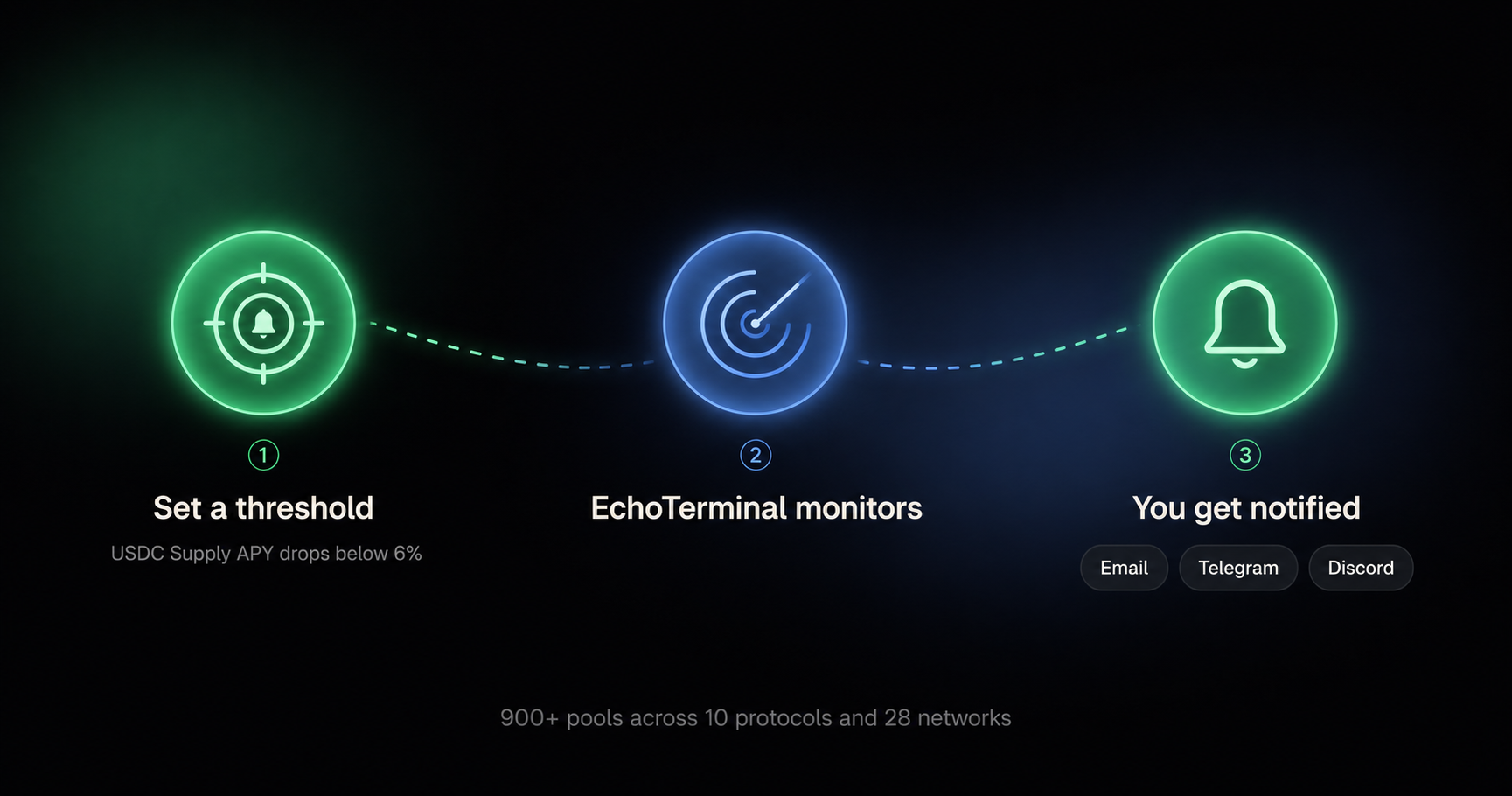
Set a threshold on any pool metric and EchoTerminal notifies you the moment it's crossed — via email, Telegram, or Discord. One-time alerts fire once and archive; recurring alerts re-arm after a cooldown you choose and keep monitoring until deleted.
#How do I get notified when a DeFi yield changes?
Create a free account, navigate to any pool's detail page, and click Set Alert. Choose the metric (Supply APY, Borrow APY, or TVL), the condition (rises above / drops below), and your threshold. EchoTerminal monitors your pools and fires a notification the moment the condition is met.
#What alert types can I set?
- Threshold alerts fire when a metric crosses a value you define. For example: "USDC Supply APY drops below 5%" or "ETH Borrow APY rises above 4%".
- TVL alerts fire when a pool's total locked value drops below a floor you set, useful for tracking liquidity risk.
- One-time alerts fire once then deactivate. Recurring alerts re-arm after a cooldown period (5m, 1h, 24h, or 7d) and keep firing until you delete them.
#Which channels can alerts be delivered to?
Email, Telegram, and Discord. You can set up all three under Profile, then Alert Methods. Each alert can notify one, two, or all three channels simultaneously. Discord delivery uses a webhook URL you generate from your server settings.
#What happens after an alert fires?
One-time alerts move to the Alert History section and deactivate. They won't fire again unless you recreate them. Recurring alerts stay active and re-arm after the cooldown you chose, firing each time the condition is met until you manually delete the alert.
Yield Calculator
The calculator lets you model a paper portfolio across any protocol and chain before committing capital. Add positions, enter amounts, and it pulls live APY to project your daily, weekly, monthly, and yearly returns. Positions auto-save and sync across devices when you're signed in.
#Can I simulate my yield returns before committing capital?
Yes. The Yield Calculator lets you build a paper portfolio across any protocol and chain. Add positions, set amounts, and EchoTerminal pulls the current live APY for each pool. The calculator projects your daily, weekly, monthly, and yearly returns so you can pressure-test a strategy before moving real capital.
#Does the calculator use live APY or a fixed rate?
Live APY wherever possible. When you add a pool from EchoTerminal's tracked universe, the current rate is fetched automatically and updates as rates change. You can also override the APY manually. Useful for stress-testing what your returns look like if rates shift to a scenario you're planning for.
#Can I model multiple positions at once?
Yes. Add as many positions as you want, across different assets, protocols, and networks. The summary panel shows your total capital deployed, the weighted-average net APY across all positions, and a combined daily/weekly/monthly/yearly yield breakdown. Your positions are saved automatically so you can pick up where you left off.
Risk & Safety
DeFi lending on established protocols has years of track record but carries real risks: smart contract bugs, oracle manipulation, liquidity crunches, stablecoin depegs, and variable rates. EchoTerminal surfaces data to help you compare — always read a protocol's own risk docs before depositing. Stablecoin yields on major platforms in 2026 typically range from 3.5% to 9%.
#Is DeFi yield safe?
DeFi lending on established protocols (Aave, Compound, Morpho) has operated for several years with billions in deposits, but risk is never zero. Smart contract bugs, oracle failures, governance attacks, and stablecoin depegs have caused losses on various protocols over the years. EchoTerminal is a data tool. We surface rates and TVL to help you compare, but we don't assess protocol safety or endorse any specific platform. Always research audits, insurance options, and the protocol's risk documentation before depositing.
#What are the main risks of supplying to a lending protocol?
- Smart contract risk: a bug in the protocol code could allow funds to be drained. Mitigated by audits and battle-tested code.
- Oracle risk: protocols rely on price feeds for collateral valuation. A manipulated oracle can trigger incorrect liquidations.
- Liquidity risk: in extreme market conditions, withdrawal queues can form if utilization hits 100%. You may have to wait to exit.
- Depeg risk: if you're supplying a stablecoin, the issuer could face insolvency or regulatory pressure.
- Rate risk: APY is variable. A 6% yield today could drop to 1% tomorrow if borrowing demand falls.
#What is a realistic APY to expect on stablecoins in 2026?
On major lending protocols (Aave, Morpho, Compound, Spark), USDC and USDT supply APYs in 2026 range from roughly 3.5% to 9%, shaped by borrowing demand and the broader interest rate environment. Rates above 10% on established stablecoin markets typically signal short-term demand spikes or unsustainable token incentives rather than durable yield. EchoTerminal's 7D and 30D average columns help you distinguish a genuine rate from a temporary spike.
Still have a question?