 Coinbase One Card
Coinbase One Card Review (2026): 2% to 4% Bitcoin Back Requires Coinbase One
 ·Co-founder of EchoTerminal | Crypto card researcher·Edited by Suriyanandan·Updated September 28, 2026·4 min read
The Coinbase One Card is a U.S. American Express credit card that earns 2% to 4% back in Bitcoin on eligible purchases. It can suit existing Coinbase One members who already hold meaningful assets on Coinbase. The main catch is that higher reward tiers require those assets and are capped at $10,000 in eligible monthly purchases.
At a glance
Rates & fees
- Cash AdvanceGreater of: $10 or 5%
Pros & Cons
What the Coinbase One Card is and how it works
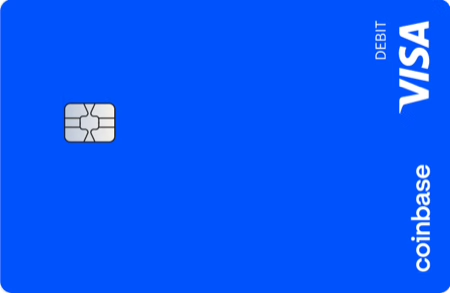
The Coinbase One Card is a physical U.S. credit card on the American Express network. It earns Bitcoin back on eligible purchases, with the everyday reward rate linked to the value of assets held on Coinbase.
It is available in the United States, excluding U.S. territories. Opening the account requires identity, income, and other application details, as well as proof of address.
Who should choose it, and who should skip it
Choose the Coinbase One Card if you are already a Coinbase One member, live in the eligible U.S. market, and are comfortable earning rewards in Bitcoin. The card is most aligned with readers who already keep more than $10,000 in assets on Coinbase and can use the higher reward tiers without moving assets solely for the card.
Skip it if you want a standalone no-fee card, do not want rewards tied to Bitcoin, or would need to buy a membership and hold a large Coinbase balance only to improve the reward rate. Readers who expect to carry a balance should focus on the APR before considering rewards.
How the asset-based Bitcoin-back tiers work
This card's most important mechanic is that the headline rate is not one rate for every cardholder. Your assets on Coinbase determine the Bitcoin-back tier for eligible purchases, and an active Coinbase One membership is required at every tier.
For example, a member with $60,000 in Coinbase assets falls in the 3% tier. That 3% rate applies to the first $10,000 in eligible monthly purchases. The tier can be valuable for a member who already has that balance, but it should not be treated as a simple 3% card without the asset condition.
| Assets held on Coinbase | Bitcoin-back rate | Monthly purchase cap |
|---|---|---|
| $10,000 or less | 2% | No cap listed |
| More than $10,000 through $50,000 | 2.5% | $10,000 in eligible purchases |
| More than $50,000 through $200,000 | 3% | $10,000 in eligible purchases |
| More than $200,000 | 4% | $10,000 in eligible purchases |
Rewards and the conditions to earn them
Regular eligible purchases earn Bitcoin at the asset-based rate. The 2.5%, 3%, and 4% tiers each have the same $10,000 eligible-purchase cap per month, so a high spending month can receive a lower effective return than the headline tier suggests.
Flights, hotels, and rental cars booked through Coinbase One Card Travel earn 5% back in Bitcoin. This travel reward is listed without a cap, but it still requires active Coinbase One membership and more than $10,000 in assets held on Coinbase.
Fees and payment costs
The card itself has no annual fee and no foreign transaction fee. That does not remove the separate requirement to keep an active Coinbase One membership, so readers should weigh the membership cost against the rewards and other membership value they use.
Cash advances are particularly costly because both a transaction fee and a 32.24% cash-advance APR apply. Avoid using the card for cash advances when possible.
| Fee or term | Amount | When it applies |
|---|---|---|
| Annual card fee | $0 | Holding the card |
| Foreign transaction fee | $0 | Purchases outside the U.S. |
| Cash advance fee | Greater of $10 or 5% | Each cash advance |
| Cash-advance APR | 32.24% | Cash advance balance |
| Late payment fee | $41 | Late payment |
| Returned payment fee | $41 | Returned payment |
| Replacement card | $40 | Card replacement |
Material drawbacks before you apply
The higher reward rates are designed for members with sizeable assets already on Coinbase. Holding or moving assets to reach a tier adds a meaningful financial decision beyond ordinary credit-card spending, and the $10,000 monthly cap limits the reach of the 2.5% to 4% rates.
Bitcoin rewards can change in value after they are received. That may appeal to readers who want Bitcoin exposure, but it is not the same as receiving a fixed cash reward.
Eligible applicants may instead be offered a USDC-secured alternative. That option requires a $200 to $5,000 USDC deposit, which sets the credit limit, even though it has similar card benefits and Bitcoin-back rewards.
Cards and variants
The collection includes one listed version: the physical Coinbase One Card. It is an unsecured credit card for the U.S. market, excluding U.S. territories, and its reward rate changes with the cardholder's Coinbase asset tier.
The secured alternative is an offer some applicants may receive, not a separate listed card version. It may fit an applicant willing to provide USDC collateral, while the listed unsecured card is the relevant option for applicants approved without that deposit.
| Option | Form | Market | Best fit | Key condition |
|---|---|---|---|---|
| Coinbase One Card | Physical unsecured credit card | United States, excluding U.S. territories | Coinbase One members seeking Bitcoin rewards | Asset-based reward tier and membership |
| USDC-secured alternative | Secured credit card offer | Eligible applicants | Applicants willing to deposit USDC | $200 to $5,000 USDC deposit sets credit limit |
The bottom line
The Coinbase One Card can be a good fit when Coinbase One membership and a qualifying Coinbase balance are already part of your financial setup. In that scenario, the 2% to 4% Bitcoin-back structure and travel reward can be useful. If those requirements would be added only for the card, the membership, asset threshold, and higher-tier cap deserve a closer calculation before applying.
Coinbase One Card FAQ
Is the Coinbase One Card worth it?
It can be worthwhile for a U.S. Coinbase One member who already holds assets on Coinbase and wants Bitcoin rewards. It is less compelling when the membership is only for the card or when the higher asset-based tiers are out of reach.
Do I need Coinbase One for the Coinbase One Card?
Yes. An active Coinbase One membership is required to open and maintain the account. The listed annual membership qualification amount is $299.99.
How does the Coinbase One Card Bitcoin-back rate work?
The rate is tied to assets held on Coinbase: 2% at $10,000 or less, 2.5% above $10,000 through $50,000, 3% above $50,000 through $200,000, and 4% above $200,000. The 2.5%, 3%, and 4% tiers are capped at $10,000 in eligible purchases each month.
What fees does the Coinbase One Card charge?
The card lists no annual fee or foreign transaction fee. A cash advance costs the greater of $10 or 5%, while late payments and returned payments each cost $41.
Does applying for the Coinbase One Card affect my credit score?
Checking eligibility does not initially affect your credit score. A hard inquiry occurs only if you accept an offer.