
Compare cards
Compare cards side by side, up to 3 at a time.
Headline cashback rates rarely match what you'll actually earn once staking requirements and fees are factored in. This table shows each card's real terms: cashback, monthly and annual fees, KYC requirements, custody model, and where it's actually available. Check the numbers here before you apply.
Select the cards you'd like to compare
Search or browse the categories below
| Overview | |||
| Issuer | Krak | ||
| Network | Visa | ||
| Card type | Physical | ||
| Last verified | Sep 2026 | ||
| Rewards | |||
| Top reward | Up to 2% cashback | ||
| Rate range | 0.5%–2% | ||
| Reward paid in | BTC or USD | ||
| Fees | |||
| Monthly fee | Free | ||
| FX fees | 1% | ||
| Card Replacement | $4.99 | ||
| PayPal Top Up | 3.39% | ||
| Wire Transfer (USD/CAD via SWIFT) | $3.00 | ||
| Apple/Google Pay Top Up | $0.25 | ||
| Debit Card Top Up | $0.25 | ||
| Annual Fee | Free | ||
| ATM Withdrawal | Free | ||
| Card Issuance | Free | ||
| Limits | |||
| ATM limit | $5,000.00 | ||
| Spend limit | $22,000.00 /mo | ||
| Requirements | |||
| KYC required | Yes | ||
| Eligibility | None | ||
| Available in | United States | ||
| KYC level | Basic | ||
| Documents required | An active Krak account with completed identity verification. | ||
| Verdict | |||
| Pros |
| ||
| Cons |
| ||
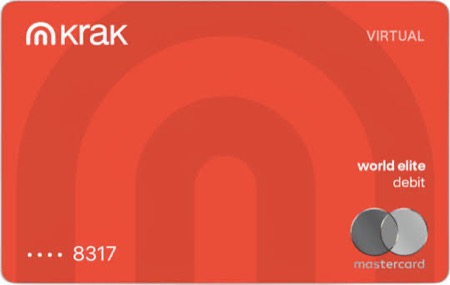
- No monthly, annual, or card-issuance fee keeps the Standard Card free to hold.
- Cashback starts at 0.5% with a $200 average asset balance and can reach 2% on eligible purchases.
- New verified customers receive 2% Max Rewards for their first 30 consecutive days.
- Cashback can be paid in USD or BTC, giving users a choice of reward currency.
- The card has published US spending limits up to $5,000 per transaction, $12,000 daily, and $22,000 monthly.
- Earning the top 2% cashback rate requires a 30-day average balance of at least $50,000 across Krak, Kraken, and Kraken Pro.
- Balances below $200 do not earn cashback, and the first earning tier pays only 0.5%.
- The cashback rate changes with the rolling 30-day average balance, so it can fall if qualifying assets decline.
- Krak Concierge travel benefits are documented for the Metal Card rather than the Standard Card.
- The card is not currently available in New York, Maine, Massachusetts, or Indiana.
Frequently asked questions
What should I compare besides the headline cashback rate?
The advertised rate is usually the maximum, and it's often gated behind a staking requirement in the issuer's own token. Compare the realistic rate at a spending level you'd actually hit, the monthly or annual fee, ATM and foreign-transaction fees, and what currency the rewards are paid in. A rate paid in a volatile token is worth less than the same rate paid in a stablecoin.
What's the difference between a custodial and a self-custodial card?
A custodial card holds your balance with the issuer and converts it to fiat at the point of sale. If the issuer fails, your funds become a claim against them, not something you can recover directly. A self-custodial card spends from a wallet whose keys you control. The issuer authorizes each transaction but never holds your balance.
Why do fees vary so much between cards that both advertise no monthly fee?
A monthly or annual fee is only one line item. Cards can separately charge for ATM withdrawals above a free allowance, a foreign-transaction spread, topping up by credit card versus debit or crypto, card replacement, and inactivity. Two cards that both advertise a $0 monthly fee can still end up costing very differently once those are added up.
Does comparing cards here change how EchoTerminal ranks them?
No. Every card is scored against the same fixed methodology, and each review is written by a named analyst and checked against the issuer's own terms. A card's rating and ranking are never changed by a commercial relationship, and no issuer can pay for a better score.
Editorial independence
Every card is scored against the same fixed methodology by a named analyst, checked line by line against the issuer's own application and pricing pages. A card's rating, ranking, and "pros and cons" are never changed by a commercial relationship, and no issuer can pay for a better score. Our opinions are our own.
Advertiser disclosure
You come first. Every time.
We believe everyone should be able to compare crypto cards with confidence. While we don't cover every card on the market, we work hard to show a wide range of issuers alongside honest, independent analysis.
So how do we make money? Some issuers pay us when you apply through our links, and in some cases applying through our link also gets you a bonus or better terms than applying directly; we note this on the card's own page whenever it's current and verified. It never changes a card's rating, ranking, or verdict. No issuer can pay us for a better score.