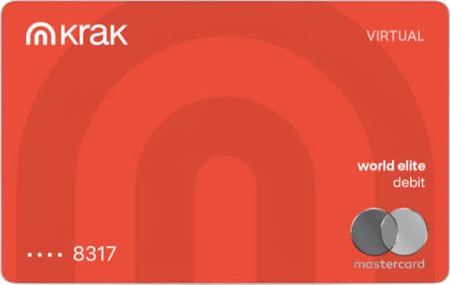
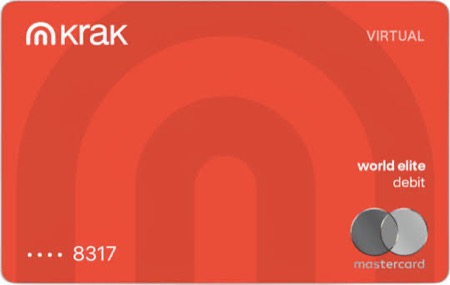
 Krak US Card
Krak US Card Review (2026): Free Debit Cards With Balance-Tiered Cashback
 ·Co-founder of EchoTerminal | Crypto card researcher·Edited by Suriyanandan·Updated September 28, 2026·4 min read
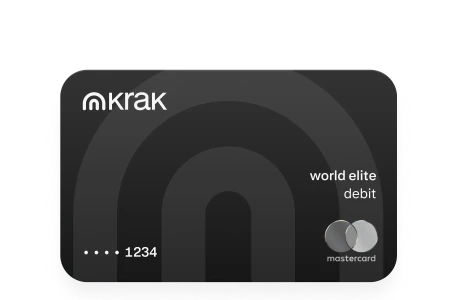
The Krak US Card is a Visa debit card with two physical options and 0.5% to 2% cashback. It can suit eligible U.S. residents who already keep qualifying assets across Krak, Kraken, and Kraken Pro. The largest catch is the rolling 30-day balance threshold, with $50,000 needed for the top rate and Metal eligibility.
At a glance
| Option | Network | Cashback | Key condition | Availability |
|---|---|---|---|---|
| Standard Card | Visa | 0.5% to 2% in USD or BTC | Cashback begins at a $200 30-day average; 2% is listed at $50,000 | Eligible U.S. residents, not all states |
| Metal Card | Visa | 2% in USD or BTC | $50,000 30-day average assets | Eligible U.S. residents, not all states |
Compare tiers
Pros & Cons
What the Krak US Card is and how it works
Krak offers two physical Visa debit card variants for eligible U.S. residents: the Krak US Standard Card and the Krak US Metal Card. An active Krak account with completed identity verification is required.
The Standard Card has no monthly, annual, or issuance fee. Its listed cashback rate starts at 0.5% for a $200 rolling 30-day average asset balance and reaches 2% at $50,000 across Krak, Kraken, and Kraken Pro. Rewards can be paid in USD or BTC.
Metal is a 16g stainless-steel card for customers with a $50,000 rolling 30-day average asset balance. It lists 2% cashback on eligible purchases and adds Krak Concierge access.
Who should choose it, and who should skip it
Choose the Standard Card if you are eligible in the United States, already keep assets across Krak, Kraken, and Kraken Pro, and want a no-monthly-fee debit card with a reward rate linked to that balance. It is most compelling when your usual balance meets one of the listed reward thresholds.
Choose Metal only if you maintain the $50,000 30-day average asset level and will use its Concierge travel benefits. Readers who do not want their card rewards tied to a platform balance, who expect frequent foreign-currency purchases, or who live in an unavailable state may find the collection less compelling.
How the 30-day average asset balance changes your cashback
The key mechanic is the rolling 30-day average of assets held across Krak, Kraken, and Kraken Pro. The listed Standard Card rate rises as that average reaches higher thresholds, so a lower qualifying balance can mean a lower reward rate.
For example, a $10,000 30-day average meets the listed 1.5% threshold, while a $1,000 average meets the listed 1% threshold. This illustration assumes eligible purchases and does not include any fee that may apply to a particular transaction.
Newly verified customers also receive temporary Max Rewards status for 30 consecutive days, with a listed 2% cashback rate.
| Listed 30-day average assets | Standard Card cashback | Practical effect |
|---|---|---|
| $50,000 or more | 2% | Top listed Standard rate; also meets Metal eligibility |
| $10,000 or more | 1.5% | Higher Standard cashback tier |
| $1,000 or more | 1% | Mid-level Standard cashback tier |
| $200 or more | 0.5% | Entry listed Standard cashback tier |
Rewards and conditions
Standard Card cashback is listed as uncapped and payable in USD or BTC. The reward range is 0.5% to 2%, with the applicable listed rate tied to the 30-day average asset threshold.
Metal lists 2% uncapped cashback in USD or BTC on eligible purchases. Its additional travel benefit is Krak Concierge, which lists members-only hotel pricing and elevated rewards on eligible Concierge bookings.
For eligible Concierge flights or hotel bookings, Metal lists 4% cashback when paid by card and 6% when paid through the Krak app. Those higher rates apply to the eligible Concierge booking, not ordinary card purchases.
Fees that matter before you use either card
The no-fee headline applies to holding and receiving either card: both list no monthly, annual, or issuance fee. Other actions can still create a charge, especially top-ups, international transactions, wire transfers, or a replacement card.
Both cards list no Krak ATM withdrawal fee, but an ATM operator may charge its own fee.
| Fee | Standard Card | Metal Card | When it applies |
|---|---|---|---|
| Monthly, annual, and issuance | $0 | $0 | Holding or receiving the card |
| ATM withdrawal | $0 Krak fee | $0 Krak fee | Operator fees may still apply |
| Foreign transaction | 1% | 1% | Foreign-currency card transaction |
| Debit card or Apple/Google Pay top-up | $0.25 plus 3.75% | $0.25 plus 3.75% | Using either listed top-up method |
| PayPal top-up | 3.39% | 3.39% | Funding through PayPal |
| USD/CAD wire via SWIFT | $3 | $3 | Wire transfer |
| Replacement card | $4.99 | $60 | Replacing the physical card |
Published spending and ATM limits
The listed limits are the same for both Standard and Metal. They are high enough for many routine debit-card uses, but the $5,000 per-transaction spending ceiling matters for larger purchases.
| Limit | Standard Card | Metal Card |
|---|---|---|
| Card spend per transaction | $5,000 | $5,000 |
| Card spend daily | $12,000 | $12,000 |
| Card spend monthly | $22,000 | $22,000 |
| ATM withdrawal per transaction | $250 | $250 |
| ATM withdrawal daily | $1,000 | $1,000 |
| ATM withdrawal monthly | $5,000 | $5,000 |
Standard Card and Metal Card compared
The Standard Card is the lower-commitment option because it offers a listed entry reward tier from a $200 average asset balance. Metal does not add a higher everyday cashback rate than the top Standard tier, but it adds a stainless-steel card and Concierge travel benefits for customers who meet the $50,000 requirement.
Both variants are physical Visa debit cards and both have no monthly, annual, or issuance fee. The practical decision is therefore less about the card fee and more about whether the Metal qualification and travel-specific benefits match how you use Krak.
| Variant | Form | Everyday cashback | Qualification | Best fit |
|---|---|---|---|---|
| Krak US Standard Card | Physical | 0.5% to 2% in USD or BTC | Listed tiers start at a $200 30-day average | Users who want the free card without Metal access |
| Krak US Metal Card | 16g stainless steel physical card | 2% in USD or BTC | $50,000 30-day average assets | High-balance users who will use Concierge travel rewards |
Bottom line
The Krak US Standard Card can be a sensible no-monthly-fee choice for an eligible user who already keeps at least $200 in qualifying assets and understands that the cashback rate follows a rolling balance. Metal is a narrower fit: it is most useful for the $50,000 qualifying-balance customer who values Concierge travel rewards. If simple fixed rewards or frequent foreign-currency spending are your priority, the balance tiers and 1% foreign transaction fee deserve close attention.
Krak US Card FAQ
Is the Krak US Card worth it?
The Standard Card can be worthwhile for an eligible U.S. resident who already holds qualifying assets across Krak, Kraken, and Kraken Pro. The card has no monthly, annual, or issuance fee, but its listed cashback rate depends on the rolling 30-day average asset balance.
How much cashback does the Krak US Card offer?
The Standard Card lists 0.5% cashback from a $200 average asset balance, rising through 1% and 1.5% tiers to 2% at a $50,000 average. The Metal Card lists 2% cashback, and both options can pay rewards in USD or BTC.
How do you qualify for the Krak Metal Card?
The Metal Card requires a 30-day average of at least $50,000 in combined assets across Krak, Kraken, and Kraken Pro. It has no subscription fee or staking requirement, and it lists 2% cashback on eligible purchases.
What fees does the Krak US Card charge?
Both options list no monthly, annual, or card-issuance fee. The listed charges include a 1% foreign transaction fee, top-up fees that vary by method, and replacement fees of $4.99 for Standard or $60 for Metal.
Where is the Krak US Card available?
The card is available to eligible U.S. residents, but not in every state. The listed unavailable states are New York, Maine, Massachusetts, and Indiana, and identity verification is required.