 RedotPay card
 Review: Quick virtual access, costly physical option

The RedotPay card gives users a quick-start virtual Visa and a physical option for in-store payments and ATM withdrawals. It fits online spenders who accept a $10 upfront virtual-card fee. The larger catch is cost: the physical card charges $100 upfront, while conversion, foreign-exchange and ATM fees can add to ongoing use.
At a glance
| Variant | Form | Network | Issuance fee | Annual fee | Welcome reward | Best suited to |
|---|---|---|---|---|---|---|
| RedotPay Virtual Card | Virtual | Visa | $10 | $0 | $5 in USD | Online and mobile-wallet spending |
| RedotPay Card | Physical | Visa | $100 | $0 | $5 in USD | In-store payments and ATM access |
Compare tiers
Pros & Cons
What the RedotPay card is and how it works
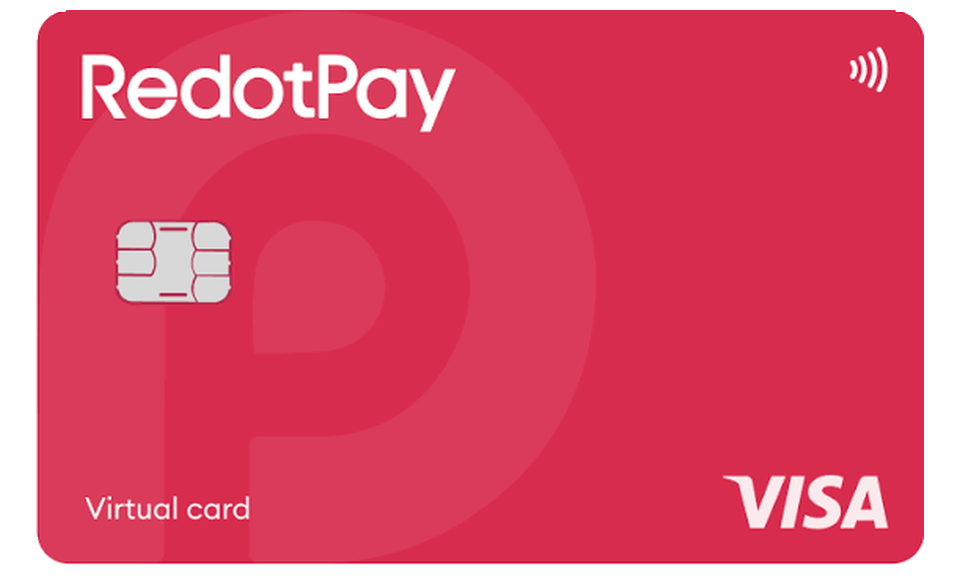
RedotPay offers one Visa debit-card collection in two forms. The RedotPay Virtual Card is built for online checkout and can be added to Apple Pay or Google Pay. The physical RedotPay Card adds tap and swipe payments plus withdrawals at compatible ATMs.
Both variants charge a one-time issuance fee and no annual fee. Each also includes a welcome reward capped at $5 and paid in USD. Basic identity verification is required before choosing a card.
The collection lists coverage across 204 countries, but the physical card is not available in every country. That makes location an important check for anyone considering the $100 physical option.
Who should choose it, and who should skip it
Choose the virtual card if online purchases and mobile-wallet payments are your main use case. It can be available for online spending within minutes, and its $10 issuance fee creates a much lower entry cost than the physical version.
Consider the physical card if you specifically need in-store tap or swipe payments and ATM withdrawals. Its $100 issuance fee is a substantial commitment, so it makes more sense for users who will regularly use those physical-card features.
Skip the physical option if you only make occasional purchases, rarely withdraw cash, or want to avoid percentage-based usage costs. The application payment for either variant cannot be cancelled or refunded, which makes checking fit and local availability before payment especially important.
The physical card's layered fees explained
The physical card has three separate percentage charges to watch. Crypto-funded spending carries a 1% conversion fee, a transaction in a foreign currency carries a 1.2% FX fee, and USD-card ATM withdrawals use a two-tier fee schedule.
For scale, $1,000 of crypto-funded spending would produce a $10 conversion fee. A separate $1,000 foreign-currency transaction would produce a $12 FX fee. These examples isolate each fee so the cost of the relevant action stays clear.
For USD-card ATM withdrawals totaling $12,000 in one month, the first $10,000 would cost $200 at 2%, and the remaining $2,000 would cost $60 at 3%. The total RedotPay ATM fee would be $260. That tier makes large cash withdrawals one of the most expensive ways to use the physical card.
Rewards are modest and easy to value
Both variants include a welcome reward capped at $5 and paid in USD. Because the reward is fixed, it offsets half of the virtual card's $10 issuance fee but only a small part of the physical card's $100 issuance fee.
The practical choice should therefore rest on how you plan to pay, not on the welcome reward. Online and mobile-wallet users have a lower-cost route through the virtual card, while physical-card users pay considerably more for in-store and ATM access.
RedotPay card fees
The fee gap between the two variants is the central decision. Both avoid an annual charge, but only the physical card has the listed conversion, FX and ATM costs below.
| Fee | Amount or rate | Applies to | When it applies |
|---|---|---|---|
| Issuance | $10 virtual; $100 physical | Both variants | Paid upfront when applying |
| Annual | $0 | Both variants | No yearly charge |
| Crypto-spend conversion | 1% | Physical card | Physical-card spending funded by crypto |
| Foreign-currency transaction | 1.2% | Physical card | Physical-card transaction in another currency |
| ATM withdrawal | 2% up to $10,000 monthly; 3% above | USD physical card | USD physical card at compatible ATMs |
The main drawbacks
The physical card's $100 issuance fee is the largest fixed cost. A user who mainly wants online access can pay one tenth as much for the virtual card and still get Apple Pay and Google Pay support.
The nonrefundable application payment raises the cost of choosing the wrong variant. This matters most for the physical card because its availability varies by country and the upfront payment is much larger.
KYC also requires more than basic account details. Applicants need an original physical ID with at least three months of validity, a face scan and proof of address before choosing a card.
Virtual card or physical card: which fits you?
The virtual card is the stronger fit for users who mainly pay online or through a supported mobile wallet. The physical card is the functional upgrade for users who need in-store payments and cash access, but its pricing requires a more deliberate use case.
| Variant | What it adds | Upfront cost | Market consideration | Best fit |
|---|---|---|---|---|
| RedotPay Virtual Card | Online checkout, Apple Pay and Google Pay | $10 | Card collection lists 204 countries | Online and mobile-wallet spenders |
| RedotPay Card | Tap, swipe and compatible ATM withdrawals | $100 | Physical availability varies by country | Regular in-store and ATM users |
Where the RedotPay card is listed
The RedotPay card collection lists Visa coverage across the following 204 country and territory codes. This is collection-level coverage. Physical card availability still varies by country.
| Code range | Listed market codes |
|---|---|
| AD to CH | AD, AE, AG, AI, AM, AO, AQ, AR, AS, AT, AU, AW, AX, AZ, BB, BD, BE, BG, BH, BJ, BL, BM, BN, BO, BQ, BR, BS, BT, BW, BZ, CA, CC, CG, CH |
| CI to GG | CI, CK, CL, CM, CO, CR, CV, CW, CX, CY, CZ, DE, DJ, DK, DM, DO, DZ, EC, EE, EG, EH, ES, FI, FJ, FK, FM, FO, FR, GA, GB, GD, GE, GF, GG |
| GH to KW | GH, GI, GL, GM, GN, GP, GQ, GR, GS, GT, GU, GY, HK, HM, HN, HU, IE, IL, IM, IO, IS, IT, JE, JM, JO, JP, KE, KG, KH, KI, KM, KN, KR, KW |
| KY to NL | KY, KZ, LA, LC, LI, LK, LS, LT, LU, LV, MC, MD, MF, MG, MH, MN, MO, MP, MQ, MR, MS, MT, MU, MV, MW, MX, MY, MZ, NA, NC, NE, NF, NG, NL |
| NO to SR | NO, NR, NU, NZ, OM, PA, PE, PF, PG, PH, PK, PL, PM, PN, PR, PS, PT, PW, PY, QA, RE, RO, RW, SA, SB, SC, SE, SH, SJ, SK, SL, SM, SN, SR |
| ST to ZM | ST, SV, SX, SZ, TC, TD, TF, TG, TH, TJ, TK, TL, TM, TN, TO, TT, TV, TW, TZ, UG, UM, UY, UZ, VA, VC, VG, VI, VN, VU, WF, WS, YT, ZA, ZM |
The bottom line
The RedotPay Virtual Card is the more accessible choice. It pairs quick online use and mobile-wallet support with a $10 issuance fee, although that payment is nonrefundable and KYC is required.
The physical RedotPay Card can be useful when tap, swipe and ATM access are essential. Its $100 upfront fee and percentage-based usage costs make it less compelling as a backup card or for infrequent spending.
RedotPay card news
RedotPay card spend at local merchants up 17.8% week over week
RedotPay says card spend at local merchants rose 17.8% week over week during TOKEN2049 week. This is a company-reported figure with no baseline amount given.
RedotPay card FAQ
Is the RedotPay card worth it?
The virtual card can be worth considering for online spenders who value quick access and mobile-wallet support enough to pay a $10 upfront fee. The physical card is harder to justify for occasional use because it costs $100 upfront and carries additional usage fees.
What fees does the RedotPay card charge?
The virtual card costs $10 to issue and the physical card costs $100. Both have a $0 annual fee. The physical card also charges 1% for crypto-spend conversion, 1.2% for foreign-currency transactions, and tiered ATM fees for USD cards.
Can the RedotPay card withdraw cash from an ATM?
The physical RedotPay Card can withdraw cash at compatible ATMs. For a USD card, withdrawals cost 2% up to $10,000 per month and 3% on the amount above $10,000.
Does the RedotPay card require KYC?
Basic identity verification is required. Applicants need to provide personal details, an original physical ID valid for at least three months, a face scan, and proof of address.
Which countries support the RedotPay card?
The RedotPay card lists Visa coverage across 204 countries. Physical card availability is not universal, so users who need the physical version should check whether it is offered in their country before paying.
What is the difference between the virtual and physical RedotPay cards?
The virtual card costs $10 and is designed for online checkout and mobile-wallet payments. The physical card costs $100 and adds tap, swipe, and ATM use, along with conversion, foreign-currency and ATM fees.